Of all the questions people quietly wonder about Hinduism, this one is perhaps the most poetic: Why did the most powerful god in the universe choose to live in the coldest, most remote, most inhospitable mountain range on Earth?
No palace. No city of gold. Just ice, snow, ash and silence.
If you’ve grown up around Hindu traditions, you’ve probably heard this asked by a curious child, a questioning relative, or maybe even yourself. And the answer is rooted in ancient Puranic texts, Vedic philosophy and thousands of years of devotional tradition is one of the most profound stories Hinduism has to offer.
1. Shiva's Himalayan Home in the Puranas
The earliest and most authoritative source on Shiva’s Himalayan connection is the Shiva Purana, one of the 18 Mahapuranas in the Hindu tradition. The text describes Lord Shiva dwelling permanently on Mount Kailash- a peak in present-day Tibet, surrounded by his attendants (ganas) and the great sages who came seeking wisdom.
The Skanda Purana, the largest of the Puranas, also extensively describes Kailash as Shiva’s abode. It refers to the mountain as Kailasa, meaning “the crystal one,” and describes it as a place where the three worlds – the heavens, the earth and the underworld, converge.
What makes these texts significant is that they don’t just say where Shiva lives, they explain why.
“As the sky is the natural home of birds, as water is the natural home of fish, so the great mountain Kailash is the natural home of Mahadeva.”
— Shiva Purana, Rudra Samhita
The texts portray Shiva not as someone who was assigned Kailash but as a being who belongs to the mountains in the same way that a river belongs to its course. The mountains are his nature, not merely his address.
2. The Story of Mount Kailash
Among the many sacred mountains mentioned in Hindu texts, Mount Kailash holds a singular position. Located in western Tibet at an altitude of 6,638 metres, it is described in the Puranas as the centre of the universe- the axis mundi, or world axis, around which everything revolves.
According to Hindu cosmology, Mount Meru the mythological cosmic mountain is often identified with or symbolised by Kailash in physical geography. The Vishnu Purana describes Meru as rising at the centre of the world, its summit touching the heavens, its roots reaching the underworld. Kailash, many scholars and devotees believe, is the earthly counterpart of this cosmic mountain.
The Mahabharata mentions Kailash several times as Shiva’s home. When the Pandavas undertake their final journey (the Mahaprasthanika Parva), they travel northward and Yudhishthira alone survives to reach the gates of heaven — implying the Himalayan peaks as the threshold between the mortal world and the divine.
Importantly, no human being has ever climbed Mount Kailash. The mountain itself, actively resists climbers. Reinhold Messner, one of the world’s greatest mountaineers, reportedly said he could have climbed Kailash but chose not to out of respect.
3. Why Shiva Chose Isolation: The Ascetic's Philosophy
Here is where the story becomes genuinely interesting and quite unlike any other deity in any other tradition.
Shiva is the Mahayogi, the supreme meditator. Before creation, before the universe took shape, Shiva existed in a state of deep, unbroken meditation. This is not metaphorical. In the Shaivite philosophy articulated in the Linga Purana and Shiva Purana, consciousness itself is Shiva. The universe arose from his opening of awareness and he can withdraw it by returning to stillness.
For a being whose nature is absolute stillness and inner absorption, the loud, busy, warm, fertile plains of India are not an appropriate home. The Himalayas, by contrast offer-
- Silence- quiet unlike rest of world
- Cold- reducing physical temptation
- Altitude- away from gravitational pull of worldly life
- Isolation- preventing disturbance from one and all
This is not a coincidence. The entire character of Shiva – the ash-smeared body, Jata (uncut matted hair), the animal skin he sits on, the begging bowl , all point to a being who has renounced the world entirely. He is the Adi Yogi (the first yogi) and the mountains are the yogi’s natural dwelling.
The great saint Adi Shankaracharya, who re-established Shaivite philosophy across India in the 8th century CE, himself chose the Himalayas for his deepest contemplations. His famous Shivananda Lahari praises Shiva precisely as the one who transcends comfort and ease.
4. Parvati and the Himalayas - A Love Story Encoded in Mountains
The Himalayan connection also has a deeply beautiful romantic dimension.
Parvati, Shiva’s consort is herself the daughter of Himavan (also called Himavat or Parvataraja), the personified king of the Himalayas. The name “Parvati” literally means daughter of the mountain (from parvata, mountain). She is, in every sense, born of the mountains.
The story of how Parvati won Shiva’s love is told in detail in the Shiva Purana and was later beautifully retold in Kalidasa’s Kumarasambhavam (The Birth of the War God), considered one of the finest Sanskrit literary works ever written. After his first wife Sati died (she immolated herself in protest when her father Daksha insulted Shiva), Shiva retreated into profound, grief-stricken meditation on Kailash. The gods became alarmed as a demon named Tarakasura could only be defeated by Shiva’s son and Shiva, deep in mourning, had renounced all worldly engagement.
Read About: Complete story of Shiv and Sati
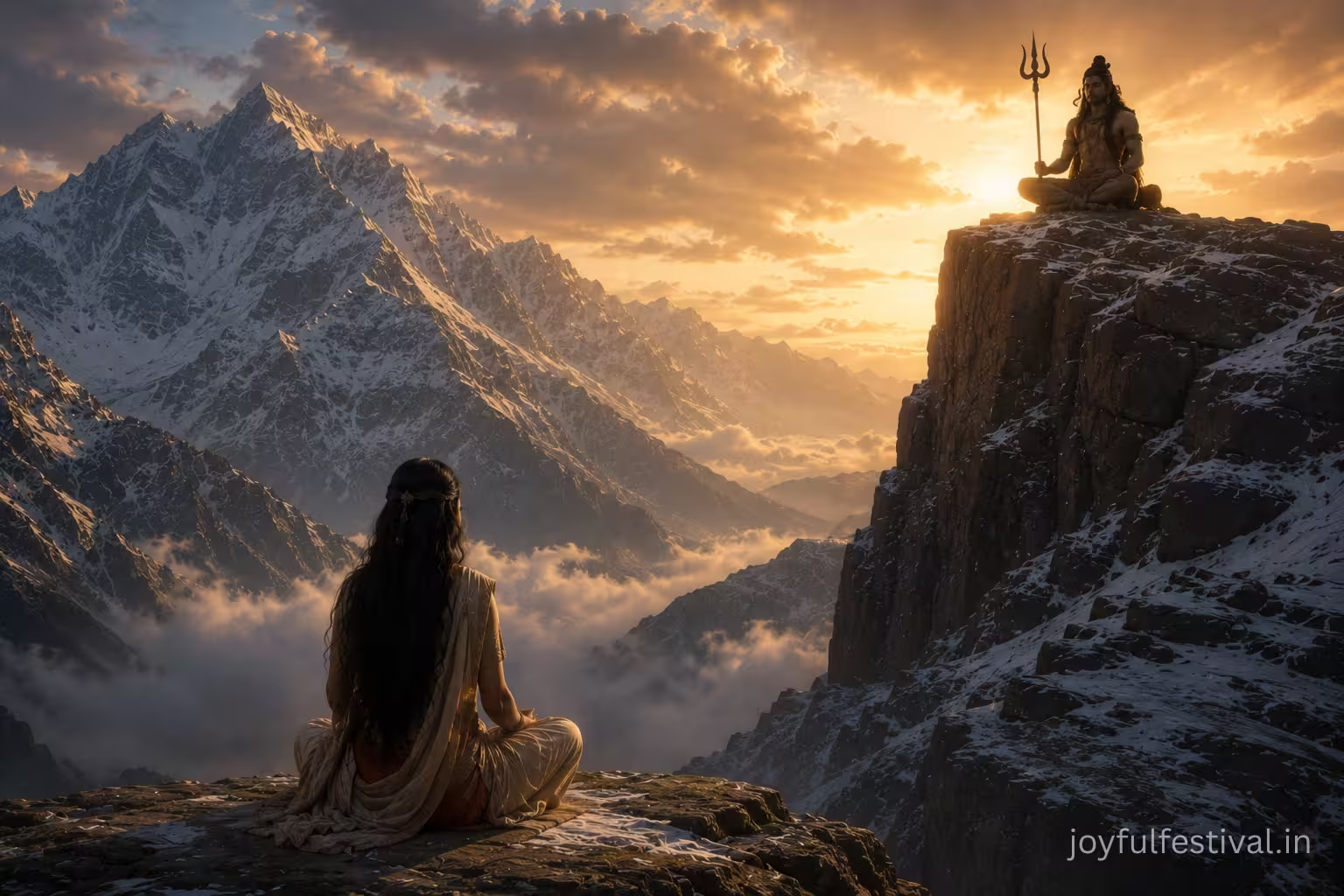
Parvati, Sati reborn as Himavan’s daughter, undertook extraordinary penance (tapas) to win back Shiva’s attention and love. She sat in the cold mountains, fasting, meditating, through snow and sun. The god of love, Kamadeva, was sent to disturb Shiva’s meditation. Shiva’s third eye opened in anger and reduced Kamadeva to ash.
But Parvati did not give up. Her persistence, devotion and the power of her own meditation finally moved Shiva. He accepted her. And thus Kailash became not just a hermitage but a home- the place where the cosmic masculine (Shiva, pure consciousness) and the cosmic feminine (Parvati, creative energy or Shakti) unite.
This union is the philosophical heart of Shaiva-Shakta tradition. The Himalayas are the meeting ground of these two cosmic forces.
5. Kailash in Other Ancient Traditions
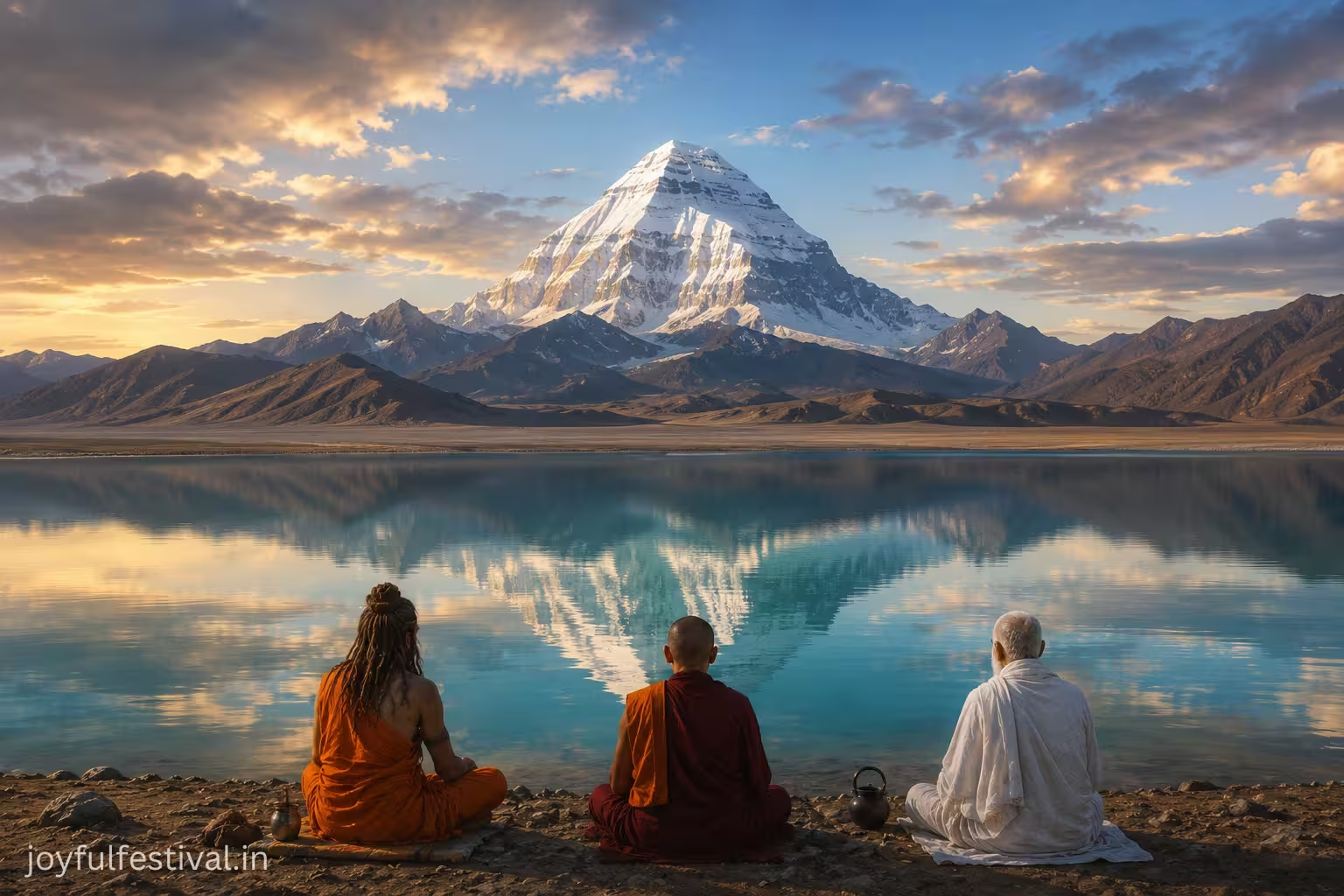
One of the most remarkable aspects of Mount Kailash’s sacredness is that it isn’t unique to Hinduism. Multiple ancient traditions independently revered this same mountain, a fact that speaks to something deeper than coincidence.
Tibetan Buddhism considers Kailash the abode of Demchok (Chakrasamvara), a wrathful deity representing supreme bliss. The Tibetan name for Kailash is Gang Rinpoche, meaning “precious jewel of snow.” Tibetan pilgrims have been circumambulating (walking around) Kailash for centuries as an act of devotion.
Jainism identifies Kailash (called Ashtapada in Jain texts) as the place where Rishabhadeva, the first Tirthankara, attained liberation (moksha). This is especially interesting given that Jainism and Hinduism developed in the same subcontinent but have distinct traditions.
Bön, the ancient pre-Buddhist religion of Tibet, considers Kailash the “nine-storeyed swastika mountain” and the soul of the entire Bön spiritual universe.
The fact that four distinct religious traditions- Hinduism, Buddhism, Jainism and Bön all independently revere this same physical mountain has led many scholars to suggest that Kailash occupies a genuinely unusual position in the spiritual geography of Asia.
6. What the Himalayas Symbolize in Hindu Cosmology
In Hindu thought, geography is never merely physical, it is always also spiritual. The Himalayas, in the Vedic and Puranic imagination, represent several profound ideas:
- The threshold between the human and the divine. Mountains are where the sky meets the earth. In many cultures and not just Hindu; mountains are sacred precisely because they are the meeting point of the earthly and the heavenly.
The power of tapas (austerity and heat generated by spiritual discipline). The Himalayas are described in the Rigveda as a place where great sages performed tapas that generated spiritual heat powerful enough to destabilise the heavens. Shiva, the ultimate ascetic, belongs here because he is tapas incarnate.
The sthira (stable) foundation of creation. In Hindu cosmology, the Himalayas are described as having stood before the world took its current form. They are older than recorded human memory and Shiva, who was before creation, naturally belongs in the place that was before history.
The mind itself. For many Vedantic thinkers, the Himalayan peaks represent the peaks of consciousness, the heights that the human mind can reach through sustained contemplation. Shiva on Kailash is, in this reading, consciousness at its most elevated.
7. Regional Variations: How Different Parts of India See Shiva's Home
While Kailash is the canonical Himalayan home of Shiva in texts, India’s relationship with Shiva is beautifully diverse and different regions have their own sacred geography.
South India, where Shaivism developed its most elaborate theological tradition (particularly through the Nayanmars and the Tevaram hymns), does not always emphasise Kailash. Instead, Arunachala (a sacred hill in Tamil Nadu) is considered by many South Indian Shaivites to be the equivalent of Kailash, a place where Shiva manifested as a column of infinite light. The Arunachalesvara Temple in Tiruvannamalai, built around this hill, is one of the Pancha Bhuta Stalas (temples representing the five elements- Prithvi, Jal, Vayu, Agni, Aakash).
Kashmir Shaivism, one of the most sophisticated philosophical schools in all of Indian thought, interprets Shiva’s Himalayan home differently. In this tradition, Kailash is not a physical place at all- it is a metaphor for the pinnacle of consciousness (paramashiva), which every individual can reach through spiritual practice.
In the Himachali and Uttarakhandi folk tradition, Shiva is deeply embedded in local landscape. He is Bhole Nath- the innocent lord who wanders the mountains freely, blesses local communities and appears in folk stories as a wandering sadhu who rewards the humble and humbles the proud.
8. The Deep Spiritual Meaning Behind the Choice
Step back and look at the whole picture: why would a text written thousands of years ago place their highest deity in the most isolated, most austere, most remote location imaginable?
The answer is philosophical, not geographical.
Hinduism, at its deepest level, teaches that ultimate reality transcends comfort, wealth and social position. The richest king in the most magnificent palace is still subject to birth, aging and death. The ascetic in the cave, undistracted by possessions or pleasure, is the one who can reach ultimate understanding.
By placing Shiva in the Himalayas far from cities, power, gold and pleasure; ancient Hindu thinkers encoded a message into mythology: The truth you seek is not found in the marketplace. It is found in stillness.
This is why so many yogis, saints and seekers throughout Indian history have gone to the Himalayas. Adi Shankaracharya established the Jyotir Math in Badrinath. The Rishikesh and Haridwar region at the foothills has been a centre of spiritual learning for millennia. The legendary Mahavatar Babaji is said to dwell in the Himalayas to this day. Swami Vivekananda meditated on Cape Comorin and the Himalayas and returned transformed.
The Himalayas are not where Shiva happened to end up. They are where consciousness naturally dwells when it has transcended the ordinary.
Also Read: “Why Do We Ring Bells in Temple? The Spiritual Meaning Explained”
9. Does Modern Science Say Anything About Kailash?
It would be dishonest to present mythological and scientific claims as equivalent, they serve different purposes and use different methods. That said, a few facts about Kailash are genuinely remarkable from a scientific standpoint and worth noting with appropriate perspective:
- Kailash stands at the watershed of four major river systems: the Indus, the Brahmaputra, the Karnali (a major tributary of the Ganges) and the Sutlej. These four rivers together drain an enormous portion of the Indian subcontinent. The mountain that ancient texts called the centre of the world literally does sit at the origin point of rivers that gave life to South Asian civilisation.
- The mountain’s shape is unusually symmetrical for a natural peak, its four faces align almost precisely with the four cardinal directions. This is geologically explicable but visually striking.
- Some researchers in the 2000s (notably a team of Russian scientists) proposed that Kailash might be a man-made pyramid structure, citing its symmetry. This remains a fringe hypothesis with no mainstream scientific support and should be treated as such.
What we can say honestly: the physical location of Kailash- at the source of major rivers, in a region of extreme isolation and natural grandeur makes it understandable why ancient peoples would have considered it cosmically significant, regardless of any supernatural claims.
10. What This Story Teaches Us Today
The story of Shiva in the Himalayas is not just ancient myth, it contains a living message-
“In a world of constant noise, constant connection and constant stimulation, the image of the greatest consciousness in the universe sitting silently in the mountains is a quiet but radical challenge.”
It asks:
When did you last sit in silence? When did you last retreat from the noise? When did you last let your mind be still?
Shiva’s Himalayan home is an invitation, not a fairy tale. It says that the highest truth, whatever you call but it is not found in the accumulated opinions and distractions of the world, instead in the quiet that remains when all of that falls away. For the devout, Kailash is the literal home of their lord. For the philosophical, it is the symbol of the highest consciousness. For the cultural, it is the heart of a tradition that has held the world’s attention for thousands of years. And for the traveller, it is perhaps the most extraordinary destination on the planet.
All of these are true. None of them are contradictions.
FAQ's
Is Mount Kailash the same as Mount Meru?
In Hindu cosmology, Mount Meru is the mythological cosmic axis — a celestial mountain. Many scholars and devotees consider Kailash to be the physical, earthly representation of Meru, though the texts distinguish between them.
Can anyone visit Mount Kailash?
Yes. Pilgrims of all faiths are permitted to circumambulate (walk around) Kailash in Tibet, with appropriate permits from Chinese authorities. However, climbing the peak itself is not permitted out of respect for its sanctity.
Why does Shiva wear ash and animal skin if he's a god?
These are symbols of his ascetic nature. Ash (vibhuti) symbolises the impermanence of the physical — even the body returns to ash. Animal skin signifies mastery over animal instincts. Together, they represent complete renunciation of worldly identity.
Do other faiths consider Mount Kailash a holy site besides Hindus?
No. Mount Kailash is also sacred to Tibetan Buddhists, Jains, and followers of the ancient Bön religion. All four traditions independently revere this same mountain, though for different theological reasons.
Did Shiva always live in the Himalayas?
According to the Shiva Purana, Kailash is Shiva’s eternal abode. However, Shiva is also described as wandering freely through the three worlds as a digambara (sky-clad wanderer). The Himalayan home represents his chosen dwelling, not a restriction on his movement.