Parv Paryushan 2026 will begin on Tuesday, 8th September 2026, and the sacred Samvatsari 2026 (also known as Forgiveness Day) will be observed on Tuesday, September 15, 2026 — as per the Jain lunar calendar.
Known as the most spiritually significant time for Jains, Paryushan encourages fasting, reflection, and forgiveness. It culminates in Samvatsari – a day dedicated to repentance and the powerful greeting:
“Micchhami Dukkadam” – “May all my misdeeds be forgiven.”
In this post by Joyful Festival, you’ll find everything you need to celebrate this sacred time meaningfully — including dates, rituals, fasting rules, Jain traditions, and forgiveness messages to share with loved ones.
Also Read:
To know more about all the dates from Holi 2026 to Samvatsari 2026
Parv Paryushan 2026 - Samvatsari 2026 Date and Jain Traditions
Paryushan is observed differently by Shwetambars and Digambars (two sects of jainism). Here’s how Paryushan 2026 will be celebrated by them
Shwetambar Jain Calendar:
Paryushan Start Date: Tuesday, 8 September 2026
Samvatsari (Forgiveness Day): Tuesday, 15 September 2026
Duration: 8 days
Focus: Reading of Kalpasutra, fasting, pratikraman
Digambar Jain Calendar:
Das Lakshan Parva Start Date: Tuesday, 15 September 2026 (tentative)
Kshamavani (Forgiveness Day): Thursday, 24 September 2026 (10th day from Samvatsari)
Duration: 10 days
Focus: 10 Dharma qualities (forgiveness, humility, etc.)
| Sect | Start Date | Forgiveness Day | Duration | Key Focus |
|---|---|---|---|---|
| Shwetambar | 8th September | 15th September (Samvatsari) | 8 days | Kalpasutra, pratikraman |
| Digambar | 15th September | 24th September (Kshamavani) | 10 days | 10 dharma qualities |
Though Shwetambar and Digambar traditions may walk slightly different paths, they are both guided by the same eternal light — forgiveness.
Gyan ka Diya — the lamp of knowledge is lit within, reminding every soul to rise above ego and walk the path of wisdom, compassion, and truth.
Parv Paryushan is not just a tradition — it is a sacred time when silence speaks, forgiveness heals, and every Jain turns inward to cleanse the soul.
This is the true essence of this Joyful Festival of the soul — uniting all Jain hearts in reflection, humility, and peace.
Ever wondered how Jain fasting affects the mind and body — or why forgiveness is considered soul purification in Jainism?
👉 Stay tuned to Explore the spiritual science behind Jain fasting and forgiveness.
Mahavir Swami’s Chyavan Kalyanak During Paryushan
What is Chyavan Kalyanak?
Chyavan Kalyanak marks the moment when Bhagwan Mahavir’s soul descended from heaven and entered the womb of his mother, Queen Trishala.
It is considered one of the five major life events (Panch Kalyanaks) in the life of a Tirthankara.
When is it Celebrated?
It is observed on the fifth day of Parv Paryushan by Shwetambar Jains
Mahavir Swami’s Chyavan Kalyanak is celebrated usually on the fifth day of Paryushan which corresponds to Tuesday, September 12, 2026
This day is also spiritually linked to dreams of Trishala Mata, which are seen as signs of a great soul’s arrival
Significance During Paryushan:
Special pujas and bhavnas are held in honor of Mahavir Swami’s divine descent
Kalpasutra recitation on this day includes the detailed story of his Chyavan and the 14 auspicious dreams seen by his mother
👉 Uncover the deeper meaning behind Trishala Mata’s 14 divine dreams in Jainism.
What is Paryushan Parv? Meaning, Rituals & Fasting Rules
Paryushan is not just a festival, it is a sacred pause in the Jain calendar.
A time when material distractions are set aside, and the soul is called inward.
The word ‘Paryushan’ comes from the Sanskrit roots:
‘Pari’ – all around
‘Ushana’ – to burn or cleanse
Together, it signifies: “Abiding from all directions to suppress inner passions and purify the soul.”
Core Purpose of Paryushan
Ahimsa (non-violence) in thought, word, and deed
Self-discipline through fasting and restraint
Scriptural study (Kalpasutra or 10 Dharma teachings)
Internal cleansing through repentance (Pratikraman)
Letting go of ego and seeking forgiveness and forgiving others
Daily Practices During Paryushan
While the values of Ahimsa, Satya, Asteya, and simple living are core to Jain life year-round, during Paryushan, these principles are followed with intensified discipline and devotion.
Common Tapasya (Types of Fasting)
| Fasting Type | Description |
|---|---|
| Ekasana | One meal per day (before sunset) |
| Biyasana | Two meals per day (strictly regulated, no taste-focused food) |
| Upvas | Full-day fast (water allowed) |
| Aayambil | One tasteless meal/day, no ghee, oil, milk, curd, fruits |
| Attham | 3-day continuous fast (no food, only boiled water) |
| Atthai | 8-day continuous fast throughout Paryushan |
| Masakshaman | 30-day fast — rare and extremely difficult tapasya |
If fasting is not possible due to age, health, or work, most Jains still strictly observe:
No root vegetables (e.g. onion, garlic, potato, carrot)
Often no green leafy vegetables either
No eating after sunset
All meals are prepared with extreme care to avoid killing even the tiniest life forms
These food restrictions reflect the deepest commitment to Ahimsa — non-violence toward all life, seen and unseen.
Spiritual Disciplines
| Practice | Meaning |
|---|---|
| Pratikraman | Self-reflection and repentance for daily karma |
| Paushadh Vrat | Living like a monk — detachment from worldly pleasures |
| Swadhyaya | Studying Jain scriptures and reflecting on dharma |
| Silence (Maun Vrat) | Practiced to calm the mind and conserve inner energy |
For a true Jain, Parv Paryushan is not about display — it is about internal cleansing.
The eyes may be closed, but the soul awakens.
This is why even a single day of sincere observance during Paryushan is considered more spiritually powerful than months of casual religious activity.
Levels of Jain Fasting & Practices (Beginner to Advanced)
Fasting during Paryushan isn’t one-size-fits-all. It’s about gradual self-restraint, mindfulness, and non-violence — not just food avoidance. Here’s a progressive list, from gentle practices to rigorous fasting:
🔹 Tivihar & Chauvihar
– No food after sunset
These are foundational Jain fasting disciplines, perfect for beginners or those with health limitations.
Tivihar: Avoid food after sunset but allow drinking boiled, filtered water at night.
Chauvihar: Avoid both food and water after sunset. Water is only consumed during the day — ideally between sunrise and sunset — because Jain philosophy believes fewer microorganisms exist during daylight, reducing himsa (violence).
These practices help align with ahimsa (non-violence) without endangering health.
🔹 Ekashana & Biyashana
Ekasana: Eating once a day, after the sunrise and before sunset nothing in between apart from boiled and filtered water only.
Biyasan: Eating twice a day, with restraint — no snacking or indulgence in between.
🔹 Aayambil
Eating once a day, without salt, oil, sweets, green vegetables, or fruits — just plain boiled grains and pulses. It’s a detox of both body and ego.
🔹 Upvaas (Complete Fast)
Fasting completely from food with boiled and filtered water, and sometimes even without water — attempted only by the very committed or experienced.
🔹 Aththam, Atthai & Masakshaman
These are advanced fasts:
Aththam: 3 days without food (3 days of Upvaas)
Atthai: 8-day fast during Paryushan (8 days of Upvaas).
Masakshaman: 30-day fast (extremely rare and requires spiritual and physical preparation).
Das Lakshan Dharma: 10-Day Virtues in Digambar Tradition
Day 1
🔸 Uttam Kshama — Supreme Forgiveness
Day 2
🔸 Uttam Mardava — Humility
Day 3
🔸 Uttam Arjava — Straightforwardness
Day 4
🔸 Uttam Shauch — Purity
Day 5
🔸 Uttam Satya — Truth
Day 6
🔸 Uttam Sanyam — Self-restraint
Day 7
🔸 Uttam Tap — Austerity
Day 8
🔸 Uttam Tyag — Renunciation
Day 9
🔸 Uttam Akinchanya — Detachment
Day 10
🔸 Uttam Brahmacharya — Supreme Conduct
Das Lakshan Dharma: 10-Day Virtues in Digambar Tradition
While Shwetambar Jains observe an 8-day Paryushan, Digambar Jains follow a 10-day spiritual journey called Das Lakshan Parva, where each day is devoted to a core Jain virtue.
Here are the 10 virtues and their meanings:
| Day | Virtue (Dharma) | Meaning |
|---|---|---|
| 1 | Uttam Kshama | Supreme Forgiveness |
| 2 | Uttam Mardava | Supreme Humility |
| 3 | Uttam Arjava | Straightforwardness |
| 4 | Uttam Shauch | Purity |
| 5 | Uttam Satya | Truth |
| 6 | Uttam Sanyam | Self-restraint |
| 7 | Uttam Tap | Austerity |
| 8 | Uttam Tyag | Renunciation |
| 9 | Uttam Akinchanya | Detachment |
| 10 | Uttam Brahmacharya | Supreme Celibacy / Conduct |
Paryushan Samvatsari 2026 - The Jain Day of Forgiveness
On the final day of Paryushan, Jains observe the sacred Samvatsari — a time to cleanse not just the body, but the karma of the soul.
What Happens on Samvatsari?
On this day:
Jains perform an elaborate Samvatsari Pratikraman — A 2–3 hour long reflection on faults committed throughout the year.
Devotees personally ask forgiveness from family, friends, and even strangers.
It ends with folded hands and the timeless phrase: “Micchhami Dukkadam 🙏” which means, ‘May the wrongs I have done — whether by mistake or even intentionally — be forgiven.’
It is a moment of complete surrender — asking forgiveness not just for accidents, but even for actions done with ego or ignorance.
This sacred phrase is said to:
Friends & family
Colleagues & strangers
Even to those we may have hurt long ago
It reflects the true spirit of Samvatsari — where forgiveness flows in all directions, cleansing both the seeker and the giver.
When is Samvatsari 2026?
Friday, 28th August 2026
Observed on the Bhadrapada Shukla Panchami tithi
Marks the 8th and final day of Parv Paryushan (Shwetambar tradition)
This day is dedicated to:
Introspection
Repentance (Pratikraman)
Seeking and offering forgiveness
Samvatsari vs. Kshamavani — What’s the Difference?
Though both days celebrate forgiveness, they differ based on sect and timing. Here’s how:
| Aspect | Samvatsari (Shwetambar) | Kshamavani (Digambar) |
|---|---|---|
| Observed on | 8th day of Paryushan | Day after Das Lakshan (10th day) |
| 2026 Date | Friday, August 28, 2026 | Sunday, September 6, 2026 |
| Ritual Practice | Samvatsari Pratikraman (3+ hours) | Personal reflection & repentance |
| Greeting Used | “Micchhami Dukkadam” | “Micchhami Dukkadam” |
| Community | Shwetambar | Digambar |
While the rituals may vary, the intention is one — to seek and grant true, unconditional forgiveness.
Forgiveness as a Spiritual Weapon
In Jainism, forgiveness is not a weakness, but a tool to break karmic chains.
Saying Micchhami Dukkadam removes:
Ego
Guilt
Hatred
Resentment
And replaces them with:
Humility
Compassion
Freedom
Why Samvatsari Matters in Today’s World?
In a world full of speed, noise, and ego, Samvatsari brings us back to what truly matters:
Peace with ourselves
Harmony with others
And clarity with the soul
It is truly a Joyful Festival of spiritual healing, one that elevates humanity through the power of heartfelt forgiveness.
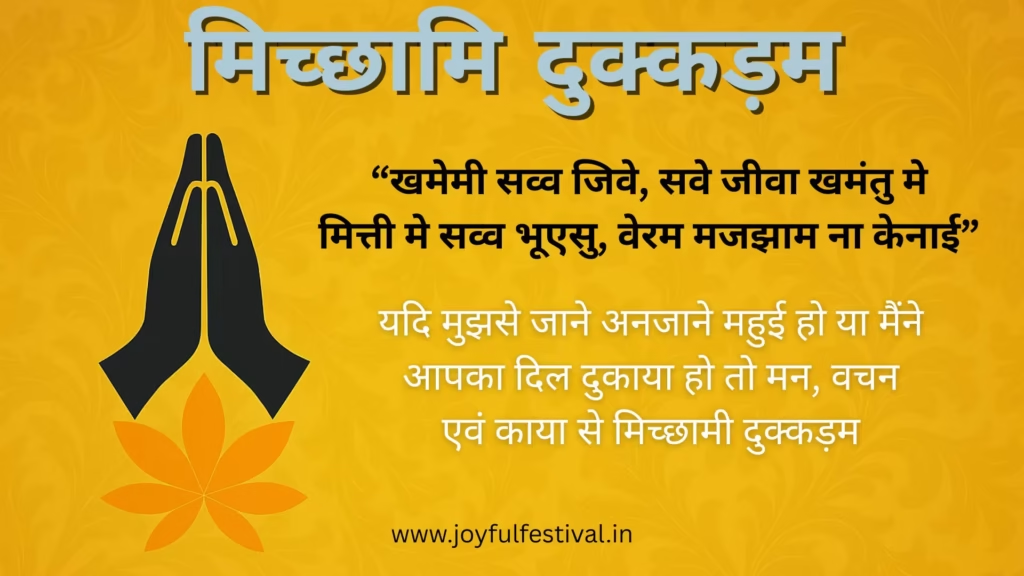
Samvatsari 2026 Messages & Quotes
Forgiveness Messages
“Paryushan Ka Aagman Hai Dharam Dhyan Ki Rut Hai Dharam Karo Karm Ko Todo Yahi Sandesh Duniya Ko Do “Jiyo Aur Jeene Do”
“Ahinsa Parmo Dharm” Jai Jinendra! 🙏“
“Today, I seek peace, not pride. Love, not ego. Michhami Dukkadam to you and your family 🙏”
“Let go of the grudge. Keep the soul light. Micchhami Dukkadam 🙏”
“शब्दों से चुभा हो कोई तीर, नज़रों ने दे दिया हो पीर,
मन, वचन, कर्म से हुई हो भूल – क्षमा करें मुझे, करूँ मैं शुद्ध दिल से कबूल।
मिच्छामि दुक्कडम् 🙏”
Powerful Quotes
“True strength lies in the ability to ask for forgiveness — and give it without condition.”
“A clean heart is the lightest thing to carry.”
“The weak can never forgive. Forgiveness is the attribute of the strong.”
“To forgive is the highest, most beautiful form of love. In return, you will receive untold peace and happiness.”
Conclusion
Samvatsari 2026 isn’t just the end of Parv Paryushan — it’s the beginning of a cleaner conscience and a lighter soul. This sacred Jain festival of forgiveness reminds us that peace is found not in rituals alone, but in letting go of resentment and embracing humility.
Whether you fasted, prayed, or simply reached out with a message of “Micchhami Dukkadam”, you’ve taken part in something powerful.
May this Day of Forgiveness help you release what no longer serves you — and walk forward with compassion.
🙏 If you found this guide helpful, please share it with others and drop your thoughts or questions in the comments below.
🪔 And if you’d like to explore more Jain festivals or spiritual insights, don’t forget to check our full archive on JoyfulFestival.in
Frequently Asked Questions (FAQ's)
Q1. When is Samvatsari 2026?
Samvatsari 2026 will be observed on Tuesday, September 15, 2026, by the Shwetambar Jain community. Digambar Jains will observe Kshamavani on Sunday, September 24, 2026.
Q2. What does Micchhami Dukkadam mean?
It means: “May all the wrongs I’ve done — knowingly or unknowingly — become null and void.” It’s a Jain way of asking for forgiveness during Samvatsari.
Q3. What is the main purpose of Paryushan?
Paryushan is a spiritual retreat focused on:
Fasting
Self-discipline
Pratikraman (repentance)
Study of Jain scriptures
Its core goal is to purify the soul and reduce karmic burden.
Q4. What is Samvatsari Pratikraman?
It’s a special yearly repentance ritual performed on Samvatsari. It includes detailed reflection on past actions, vows, and seeking forgiveness from all living beings.
Q5. Can non-Jains say Micchhami Dukkadam?
Absolutely. The spirit of forgiveness transcends religion. Anyone can say it with sincerity and offer peace to others.